Leicestershire’s Charnwood Forest took an important step towards gaining a prestigious international designation last week.
Charnwood Forest’s UNESCO Global Geopark application was submitted to UNESCO HQ in Paris on Friday. The bid for Geopark status is based on the area’s world famous fossils from around 565 million years ago. Since the discovery of Charnia by two school children in the 1950s, many other fossils have been described from the Geopark, including Auroralumina attenboroughii, the oldest known fossil of a predatory animal.
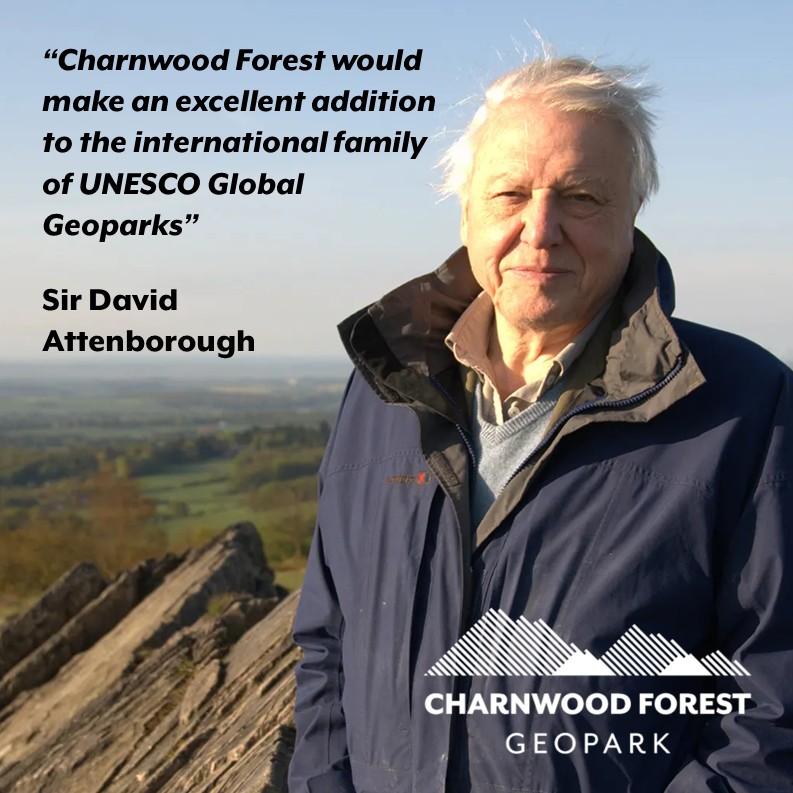
When people tell the story of the evolution of life on planet Earth, they speak of Charnwood Forest. In 2010 the Discovery Channel, ABC, and the BBC joined together to make the Emmy-award winning TV documentary series First Life, and it was in Charnwood Forest where the programme began. Standing atop the summit of Beacon Hill, Sir David Attenborough welcomed the viewers: “As a school boy, I grew up near here. And in these rocks, a discovery was made that transformed our understanding of that mystery of mysteries: the origin of life.” Noting Sir David’s personal and professional links to Charnwood Forest, we are deeply honoured to have his endorsement, in which he says: “Charnwood Forest would make an excellent addition to the international family of UNESCO Global Geoparks”.
Charnwood Forest Geopark has been developed over the past four years as part of a National Lottery Heritage Fund supported Landscape Partnership Scheme, hosted by the National Forest. The Geopark includes well-known sites such as Bradgate Park and Beacon Hill, but also hidden gems like Morley Quarry and Markfield’s Hill Hole. Charnwood Forest’s application for UNESCO Global Geopark status totals more than 140 pages, and outlines details of recent work that has been undertaken in areas such as education, interpretation, conservation, and sustainable economic development. The UNESCO bid has been possible thanks to financial commitments made by four local councils: Charnwood Borough Council, Hinckley & Bosworth Borough Council, Leicestershire County Council, and North West Leicestershire District Council.
There are currently 229 UNESCO Global Geoparks in 50 countries, each hosting internationally significant geological features that communities use to support education work and growing the local economy in a sustainable way. In 2026 two international evaluators will visit to judge if the region meets the high standards of a Global Geopark. If all goes well, Charnwood Forest will be awarded the status when the UNESCO Executive Board meets in the spring of 2027.
Charnwood Forest’s newest fossil is Charnia brasieri. If you want to learn more about this new species of Charnia, join us for a free online public talk by Prof Duncan McIlroy on December 9th.