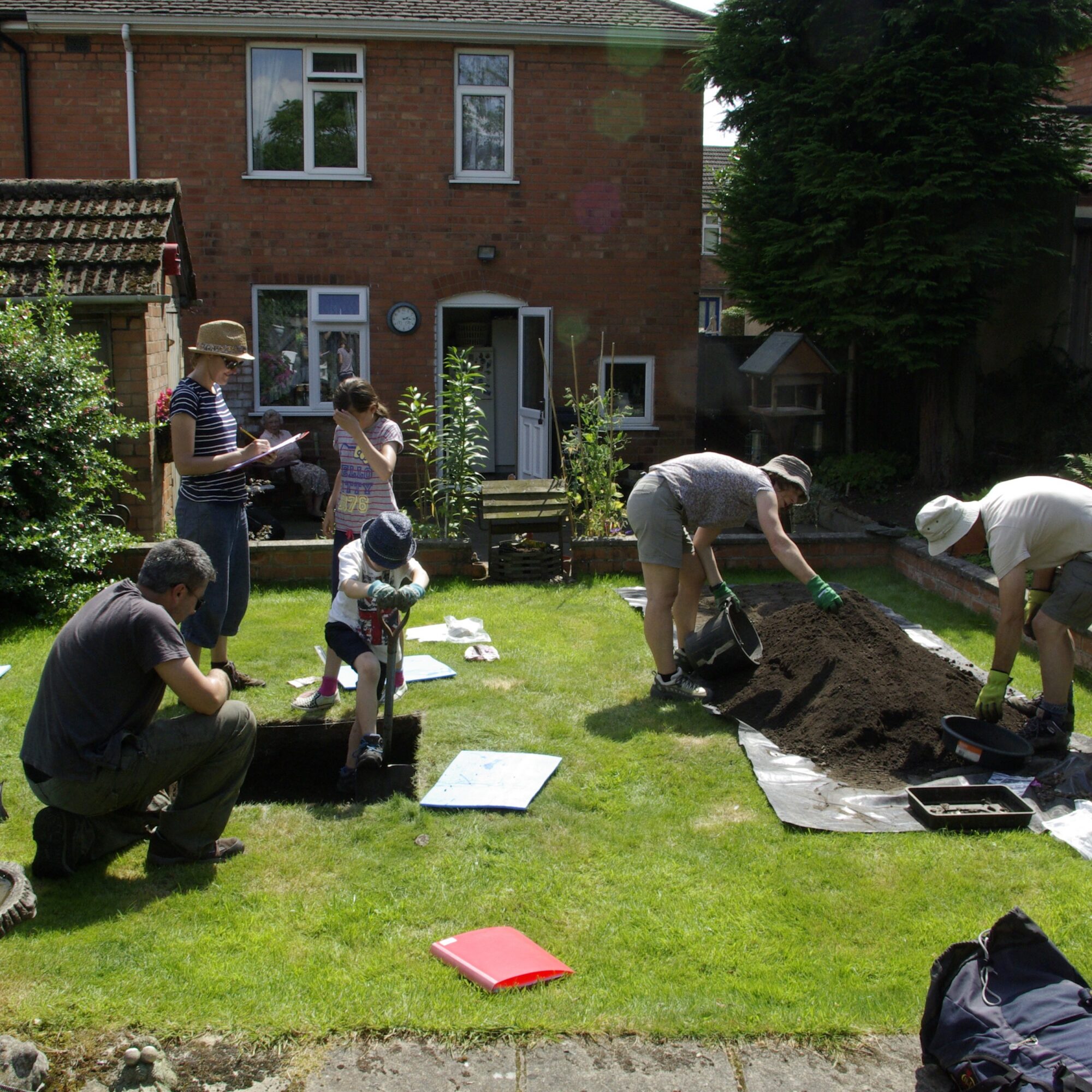
This spring and summer, communities across Charnwood Forest have an extraordinary opportunity to uncover the deep histories lying beneath their lawns, village greens and garden soil. As part of Charnwood Forest Geopark’s Charnwood Forest Uncovered project, up to 90 archaeological test pits will be excavated across Newtown Linford, Stanton Under Bardon, and Woodhouse and Woodhouse Eaves between May and July 2026. Local residents and volunteers are warmly invited to take part.
Led by Professor Carenza Lewis from the University of Lincoln (well known from Channel 4’s Time Team) together with archaeologists from University of Leicester Archaeological Services, the project is funded by the National Lottery Heritage Fund.
Why Test Pits Matter
Test pits are small but powerful archaeological windows. Each 1m x 1m excavation offers an ideal way to explore gardens and village spaces without major disruption. Each pit may reveal pottery and other artefacts that shed light on everything from prehistoric activity to medieval settlement and later village life. Previous digs in nearby villages uncovered thousands of finds, some dating back thousands of years, filling gaps in village histories and showing the impact of major events such as the Black Death.
At the end of the weekend, the pits are refilled and turf replaced, but the information gained becomes part of the growing story of life in Charnwood Forest.
Newtown Linford (2–3 May 2026)
Despite its picturesque charm and well-known historic surroundings, surprisingly little is known about Newtown Linford’s earliest origins. It does not appear in the Domesday Book (AD 1086) or other early medieval records, with the earliest reference for Lindeneford in 1280 and Neuton in 1325. Archaeological investigations have also been limited, but hints of prehistoric, Roman, and medieval activity all point to a rich story waiting to be explored.
Learn more: https://ulasnews.com/2026/02/27/charnwood-digs-newtown-linford-faqs/
Register to take part: https://forms.office.com/e/j86rFBNHxC
Stanton Under Bardon (16–17 May 2026)
Unlike the other villages, Stanton Under Bardon is mentioned in the Domesday Book as Stantone. Still, surprisingly little is known about the settlement lying beneath today’s streets and gardens. The village’s complex manorial past, its shifting centre of occupation, and hints of prehistoric, Roman, and medieval activity all point to a rich story waiting to be explored. Yet much of the modern village has never been investigated archaeologically.
Learn more: https://ulasnews.com/2026/02/16/charnwood-digs-stanton-under-bardon/
Register to take part: https://forms.office.com/e/xqL9xF1AHs
Woodhouse and Woodhouse Eaves (4–5 July 2026)
Despite their picturesque charm and well‑known historic surroundings, surprisingly little is known about the earliest origins of either Woodhouse or Woodhouse Eaves. Neither village appear in early medieval records, including the Domesday Book, with the earliest reference for Woodhouse in 1209 and Woodhouse Eaves in 1481. Archaeological investigations have also been limited, but hints of prehistoric, Roman, and medieval activity all point to another rich story waiting to be explored.
Learn more: https://ulasnews.com/2026/02/17/charnwood-digs-woodhouse/
Register to take part: https://forms.office.com/e/w5Z267B9E1
Get Involved
Volunteers can get involved in several ways: by offering a patch of garden for a test pit, joining a team of diggers, or helping with finds washing and recording. No experience is needed, and all ages and abilities are welcome. It’s a fun, fascinating way to spend a productive weekend with family, friends and neighbours!
To volunteer or offer a site, email dig.charnwood@leicester.ac.uk or use the relevant village registration form:
- Newtown Linford: https://forms.office.com/e/j86rFBNHxC
- Stanton Under Bardon: https://forms.office.com/e/xqL9xF1AHs
- Woodhouse & Woodhouse Eaves: https://forms.office.com/e/w5Z267B9E1